


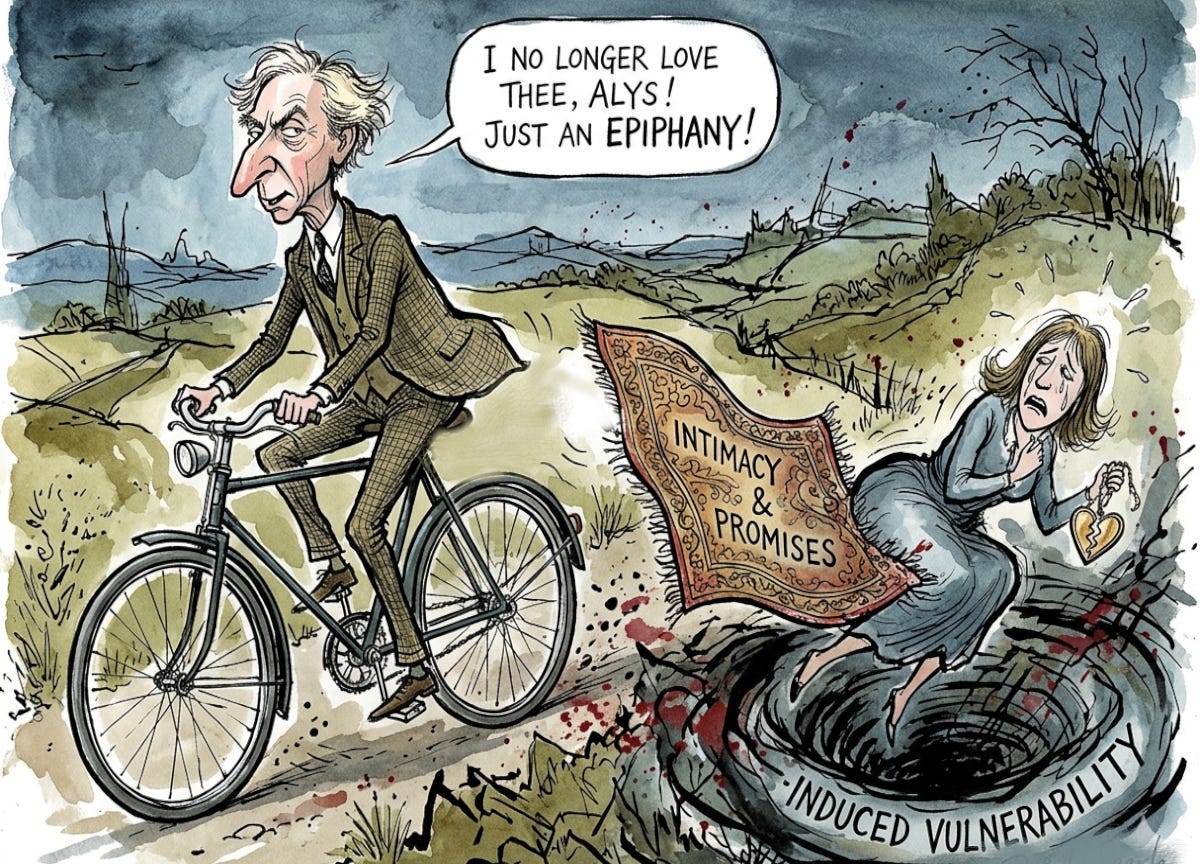
This essay grapples with the thorny question of what we owe to another person after becoming central to their life, particularly in the context of the breakdown of an intimate relationship. To anticipate, the argument we’ll make here is that while the right to leave is real, and sometimes must be exercised, the moral status of leaving remains very much up for grabs. The claim is not that anyone can be forced to carry on loving, or that every unhappy relationship should continue. Of course it isn’t. It is rather that sometimes we cannot leave without being morally tainted even when departure is necessary.
The Modern Exit Doctrine
The modern view is neatly captured by the idea that no one owes another person a relationship. If someone no longer wants to stay, that fact is treated as self-authorising. They may leave because they want to leave, and the person left behind has no right to litigate whether the reasons given, if they are given, adequately justify the departure.
This view has real force. Even in the absence of abuse or degradation, a relationship where one person wants out but can’t readily leave can quickly become intolerable. Feminists have understood this point for decades. Women need an escape route because of the prevalence of male violence. But the question is whether the modern view is just a little too easy – whether it tends to gloss over promises, structures of dependence, vulnerability, and predictable harm.
To illustrate some of the philosophical nuance, let’s consider a real-life case involving a British philosopher revered, mistakenly, for his wisdom and humanity.
Alys Pearsall Smith and the Scoundrel
Alys Pearsall Smith married the British philosopher Bertrand Russell in 1894, and for several years thereafter was “deliriously happy”, living with the man she considered her “ideal companion”. Unfortunately, her idyll did not last, shattered, probably on a rainy Tuesday afternoon, while her husband was out on a little two-wheeled adventure. Here’s how the man himself described the unfortunate event:
I went out bicycling one afternoon, and suddenly, as I was riding along a country road, I realised that I no longer loved Alys. I had had no idea until this moment that my love for her was even lessening. [Russell, 2014, p. 150]
Russell was perfectly well aware that this was disastrous for Alys. He reported that they had always lived in the closest possible intimacy, that they talked over everything together, and that Alys was besotted with him. But that didn’t matter, because in intimate relations one should always speak the truth, especially if one discovers it suddenly as an epiphany on a bike ride among the hedgerows of Cambridgeshire.
Alys, naturally, was devastated by the revelation, but implored Russell to continue to live with her and to carry on their normal life, which he magnanimously agreed to do because he didn’t yet have a replacement for her.
Unfortunately, a decade later, he managed to find at least a temporary substitute for Alys – Lady Ottoline Morrell – so off he trotted.
What’s At Stake?
So why does this matter? What justifies the rhetorical roasting?
Well, it matters because Russell presided over – indeed, caused – the psychological destruction of a woman to whom he had vowed love and fidelity, a person who had caused him no harm and who would reasonably have expected, given the tenor of the times, that organising the rhythm of her life – emotional, social and practical – around her marriage did not need to come with a giant government health warning. It would have been absolutely obvious to all concerned that the collapse of her marriage was always going to fall more heavily on Alys than Russell.
Yet Russell’s justification was just this: he didn’t love her anymore. That was it. No other reason.
The strong view is that this is not a good enough justification. That Alys was owed better. That Russell behaved like a scoundrel.
His Aunt Agatha understood the point well.
Aunt Agatha
Agatha is to be admired for her willingness to tell her nephew just what she thought of his morals. He had complained to her that she still had a picture of Alys on her mantelpiece. She responded by upbraiding him in a letter. She did not deny Russell’s unhappiness, and she did not pretend that love could be manufactured by duty. Her complaint was that he had centred his own pain while treating Alys’s suffering as an unfortunate side-effect of his sincerity.
It would have been more manly and chivalrous of you to write me not to withdraw friendship from the woman you brought into the family, the woman you once loved and had forsaken, though her love was unchanged… You now in these later times always speak of “pain to me”, “giving me pain”, etc. – Do you ever think of Alys’s suffering – from her love for you. [Monk, 2000, p. 86]
It is worth saying a little bit about Alys’s suffering to bring into sharp focus the major weakness of the modern exit doctrine. She never recovered, never remarried, and never stopped loving Russell, even into old age. Russell shattered her inner world, and she was never able to put it back together again.
Alys tells us that after he left she was unable to meet him again for “fear of the renewal of my awful misery”. She says that sometimes she used to watch him reading to his children through the uncurtained windows of his Chelsea home, and that she had been unable to prevent “this one disaster from shattering my capacity for happiness and my zest for life”.
In this context, Aunt Agatha’s central question lands hard: Do you ever think of Alys’s suffering – from her love for you?
There is no prudishness here, no condemnation of Russell’s philandering. Nor is there a demand for heroic self-sacrifice and lifelong captivity in a one-sided marriage. Rather, Agatha is advocating for tenderness towards the person whose emotional dependence remained untouched even after love had wandered off to Bloomsbury. Put another way, the point is this: you don’t break apart the life of a person who quite reasonably expected you to be their protector, and then unilaterally abandon them to their fate.
Do Promises Count for Nothing?
There are strange asymmetries in how we tend to view honesty, commitment, and duty within intimate relationships, which suggest that the modern exit view is perhaps a little brittle. It is trivially easy to find cases where self-authorisation does not function as a moral disinfectant.
Take David, a hypothetical husband and father who has fallen in love with ultra-running. On the trails, he believes he is at one with Mother Earth and at last discovering his true nature. Unfortunately, having Gaia as a bestie requires him to spend nearly all his free time away from home, leaving his wife to look after their children, their house, and the thousand dreary obligations of family life, all in the teeth of her own loneliness.
Nobody sensible will think that this is okay. David cannot self-authorise his way out of his family responsibilities. It doesn’t matter that he does not aim harm at his wife, it doesn’t matter that he is living his own truth. He’s violating the shared understandings upon which his relationship is based, and he will be judged appropriately for the breach. If you accept this point, it means you think that in some contexts at least, perhaps in many contexts, promises matter, predictable harm matters, and that authenticity and speaking the truth are not moral solvents.
The curious thing about all this is that many people would judge David less harshly if he just upped and left his wife: “I don’t love you, darling. I’ve found my calling in the Surrey Hills.” Hyperbole, perhaps, but let’s not forget how close this is to the line Russell spun to justify betraying Alys; just substitute Bloomsbury for Box Hill.
But there is a wrinkle here: children.
Won’t You Think of the Children?
One obvious difference between the Russell and David cases is the presence of young children. The natural thought is that Russell can leave with his morals intact because there are no little ones in play, while David cannot. However, the difficulty is that when you cash out what this difference means in terms of the ethics of leaving, it tends not to help the modern exit doctrine. Here’s why.
If you analyse what it is about childhood that makes abandonment morally impermissible, you are predictably going to talk about dependence, vulnerability, lack of agency, and the absence of autonomy. In a nutshell, it is wrong to abandon a child because they are morally innocent, they are not going to cope on their own, and they have done nothing to deserve the emotional distress that will inevitably result.
You can probably see where this is going. There is no doubt that this sort of asymmetry is characteristic of the relation between children and their parents. The thing is, though, something like it was also true of Alys’s relation to Russell. Moreover, Alys is hardly unusual in this regard. It isn’t a contentious claim to say that adults, more generally, can easily become dependent in relationships, making them vulnerable to harms they did nothing to provoke, and that they will often lack the resources – social, emotional and economic – to escape or repair the asymmetry that has come to define their intimate life. Of course, we have got to be careful not to infantilise people who have been wrecked by romantic betrayal. But the reality is that if you fall in love, and weave the fabric of your life around the promises of another person, your deep reliance upon that person’s presence leaves you vulnerable to a hurt that cannot easily, if at all, be undone. As everybody knows, the liberal notion of rational actors calmly acting in their own best interests quickly falls by the wayside in the face of profound lovesick longing.
It is important to get clear on what’s at stake here. The argument is that children are a factor in a moral calculus that determines when and how you may leave a relationship. Children are dependent and vulnerable, so you can’t just abandon them because you’ve taken a fancy to Lytton Strachey. This will be generally accepted. The problem for the modern exit view is that adults can also stand in relations of dependence and vulnerability to their intimate partners. If this sort of asymmetry can rule out leaving in the case of children, then why not in the case of adults? Remember, you can’t just reply, “well, adults are not children”, because the reason we invoked dependence and vulnerability in the first place was to shore up the intuition that children are a special case. To emphasise: the argument isn’t that adults are children, it is that dependence and vulnerability don’t cease to matter just because the asymmetrical relation is between two adults.
This all leaves the modern exit view in a bit of difficulty. If dependence and vulnerability make moral claims, then they have to be part of any moral calculus of leaving. That is incompatible with the view that each person has an inalienable moral right to leave just on the grounds that they want to leave. You might try to rescue the modern view by suggesting it’s only in rare, tragic cases – a spouse dying of cancer, for example – that we have to factor in the claims of another person. But that’s not going to help you. Once you accept that a person’s vulnerability can bear on the rights and wrongs of leaving at all, you’ve conceded that wanting to leave is never enough. The argument isn’t really about the extreme cases. It’s about whether “because I want to” self-authorises. It doesn’t.
Induced Vulnerability
In place of the modern exit view, I want to argue for an approach based on the idea of induced vulnerability. The broadest statement of the principle underpinning this approach is as follows: what we owe to another person will be transformed within the nexus of a intimate relationship to the extent dependence and vulnerability emerge in the sort of context that can predictably have that effect.
That is probably a little abstract to land well, so here’s the rock ‘n roll version. If you don’t want to find yourself burdened with moral duties that flow from another person’s dependence on you, don’t get involved in intimate relationships in the first place, because whatever you say about your intentions up front, however much you disavow your romantic seriousness, intimacy is precisely the sort of context in which psychological dependence, and the vulnerability that flows from it, are predictably forged.
This is stronger than saying that we are only responsible for dependencies we intended to create. In certain domains, dependence and vulnerability are predictable. Think of the relationship between teacher and pupil, if you want a non-romantic example, or between therapist and client. This is not news to anybody, I hope.
Likewise, it will not be news to anybody that the romantic and sexual domains are archetypal sites of dependence and vulnerability. Intimacy is a practice in which radical vulnerability is predictably induced. To love someone, and to allow oneself to be loved, is to enter a domain where each person becomes capable of damaging the other in ways that strangers cannot.
More On Promises
There is no doubt that promises impose certain kinds of moral obligations upon people. If your name is Jonathan Trager, and you’ve promised to marry somebody, but you decide mere hours before your wedding that the universe is telling you that you belong to somebody else, and you beetle off to lie on an ice rink instead, then unless a large part of the population has been seduced by Hollywood glitz and Nick Drake, people are going to think you are a bit of a cad. As you would be. So promises count.
However, the duties that flow from induced vulnerability do not depend on promises. Neither do they depend on ceremonies, rituals or the longevity of a relationship, though all three, through processes of emotional entrenchment, might deepen those duties. The moral obligations predicated on induced vulnerability can be rooted in a shared life; in moments of emotional intensity; in ecstatic physical relations; in the asymmetrical psychology of attachment; in the fabric of the everyday.
The principle we’re developing is in some respects stringent. It might require not only that people leave well, but that they do not leave at all. You may be balking at such a suggestion, but actually there’s a good chance you’re already committed to it. Imagine the spouse dying of cancer; the couple dealing with the death of a child; or someone who has crossed the world and broken with family, friends and work to embark on a new relationship. In these threshold cases, the injunction, “Do Not Leave”, is not unreasonable, given that the dependence and vulnerability are grave and constitutive of the relationship itself.
This is not merely the old Christian view that marriage is a God-sanctioned bond, and that to break it is to violate a sacred obligation. It is the thoroughly modern claim that intimate relations sometimes create a duty of asymmetric care, and that decent conduct might require setting aside one’s own immediate self-interest just in those circumstances where another person’s life has been made vulnerable by one’s own invitation, promise or behaviour.
Not Romantic Ownership
Now we’ve reached the tricky bit. There’s an obvious objection to the claim that duties flow from induced vulnerability: namely, that it can be weaponised. It’s not rare for an abuser to tell his victim that really it’s her fault it all happened, because if she hadn’t made him love her so much, then he wouldn’t have been jealous in the first place.
The first point to make about this is that it’s got the theory of induced vulnerability precisely backwards. The victim of abuse doesn’t induce dependence or vulnerability in an abuser by being the target of their abuse. That doesn’t make any sense. True enough, there’s an asymmetrical relationship, but the abuser is precisely on the wrong pole of it for any claim of rights against his victim to get off the ground. To put it another way, you don’t get to claim rights based on your “dependence” when all your behaviour suggests it has grown, if it exists at all, out of the violence and abuse you direct towards your victim.
Another important point to make here is that duties almost never require that you remain in a situation that threatens you with significant harm. Imagine you had been lovingly married for many years before your spouse developed a brain tumour that altered their behaviour. They become abusive and violent. If their behaviour had remained unaltered, then they would have held rights against you as a result of duties that had deepened over many years. But the extent and character of those rights is radically transformed by their turn towards violence even though they are not responsible for its occurrence. Staying in a dangerous situation might be supererogatory, but the turn to violence defeats any duty to remain that years of love and dependence might otherwise have generated.
This leads on to a more general point about this approach. It is not a theory of romantic ownership. The more vulnerable person does not acquire property rights in the less vulnerable one even if their vulnerability is genuine – as in the brain tumour case. Love cannot be commanded, of course, and normally the duty imposed by induced vulnerability will simply be to leave correctly, with proper attentiveness to timing, honesty, continuing presence and mitigation. In particular, one must show genuine willingness to let the other person understand what is happening to their own life, acknowledging that they too are an end in themselves, with their own projects, hopes and fears. The most stringent demand not to leave will only arise in circumstances marked by grave vulnerability, often involving dependent children, serious illness, social isolation, economic dependence, and so on.
Moral Residue
As we have seen, the principle of induced vulnerability doesn’t say exit is always forbidden. Sometimes leaving is the least bad thing available; and sometimes remaining, particularly in the context of a thoroughly dysfunctional relationship, with patterns of abuse on both sides, would be degrading, dangerous, and not something either party could reasonably want.
The messy truth about relationships is that duty is fragile, and can be easily shattered in the context of a complete breakdown of relations. It is a reasonable metric to say that duty is dissolved in proportion to the level of risk, both psychological and physical, that is involved in continuing with a relationship. You are not required to be complicit in your own psychological annihilation just in order to live up to an abstract principle that normally doesn’t demand staying anyway.
But it should be understood that even a permissible exit can leave a moral residue. Doing the least bad available thing doesn’t make you morally clean. The harm you leave behind clings to you as a reminder that human interconnectedness comes with moral risk. The modern liberal often treats permissibility as a cleansing verdict: either you were entitled to act, or you were not; if you were entitled, the matter is closed. The view defended here refuses that neatness. You may be permitted to leave. You are not permitted to feel about it as though you had merely trotted off to Bloomsbury or Box Hill.
Let’s give Alys the last word. In 1949, Russell and Alys renewed their acquaintance and began a correspondence that continued for two years until her death. In April 1950, aged 82, Alys sent Russell the following letter:
I have so enjoyed our two meetings & thee has been so friendly, that I feel I must be honest & just say once (but once only) that I am utterly devoted to thee, & have been for over 50 years. My friends have always known that I loved thee more than anyone else in the world, & they now rejoice with me that I am now able to see thee again. But my devotion makes no claim, and involves no burden on thy part, nor any obligation, not even to answer this letter. But I shall still hope thee can spare time to come to lunch or dinner before very long… Thine ever, Alys. [Russell, 2009, pp. 520-21]
References
Russell, B., Autobiography, Routledge, 2009.
Russell, B., The Autobiography of Bertrand Russell, Routledge, 2014.
Monk, R., The Ghost of Madness, Jonathan Cape, 2000.
Hello Jeremy, it's great to hear from you again. I had missed your reflexions.
Have you read Eva Illouz's book The End of Love? Eva is a Marxist of sorts, not the Che Guevara kind, but more the Adorno kind. She analizes how love has become a supermarket or Amazon where we pick the product that appeals to us most and then discard it when a new product appears on the market. Eva suggests that just as we have rules for financial markets, we need rules for love. She's not talking about written laws obviously, but codes that dictate, for example, that you shouldn't dump a vulnerable person who depends on us. I agree. By the way, Eva uses the example of Russell in her book.
She's a sociologist. There are a lot of interviews in the book. She uses the Russell story as one example of a type of breakup, the sudden revelation. Another is a building up of petty grievances. I don't recall the whole list, but she doesn't go into details about Russell.