

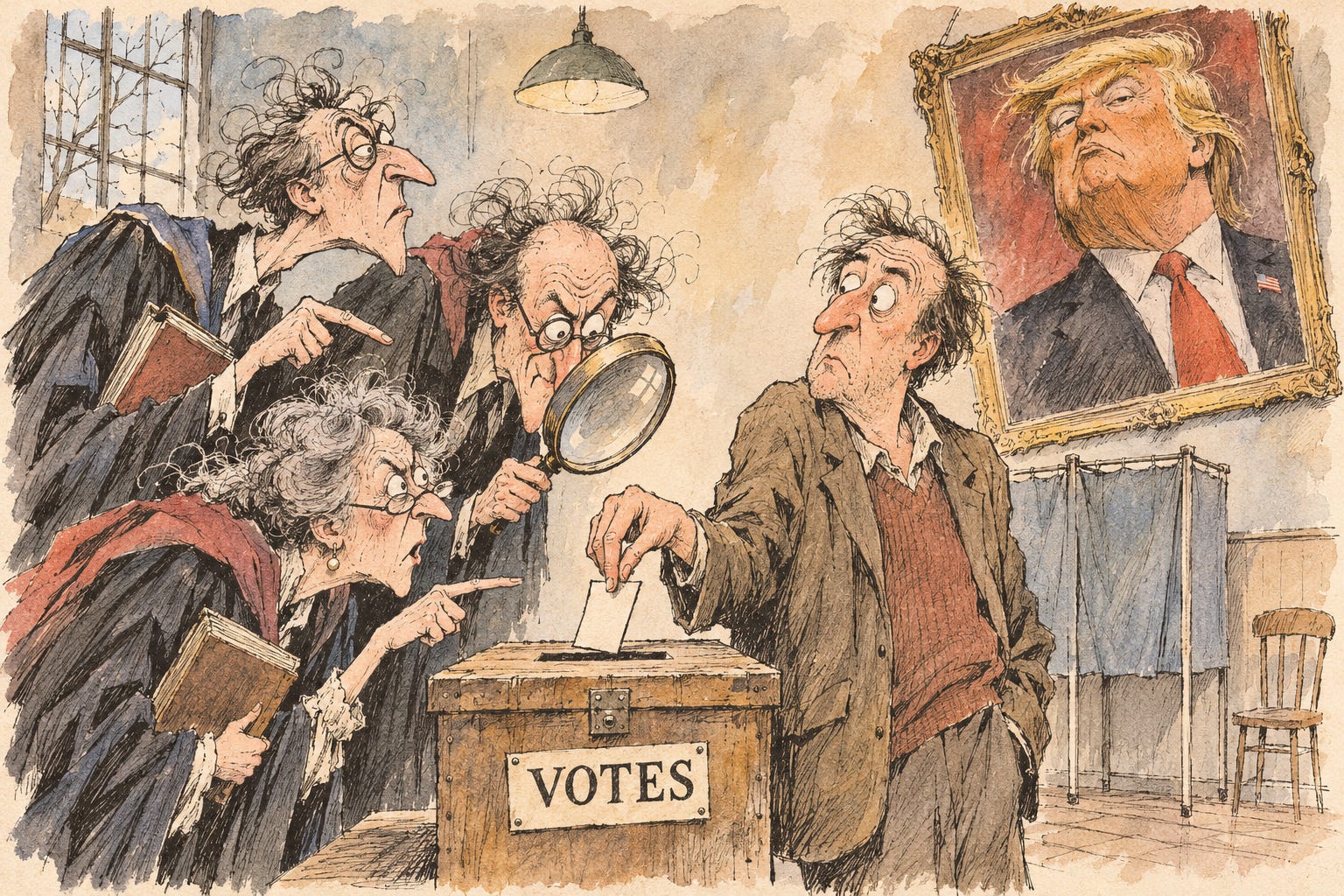
It’s fair to say that not all philosophers reacted to the victory of Donald Trump in the 2016 presidential election with unconstrained joy. A survey of philosophical opinion, albeit unrepresentative, published at the Daily Nous web site a couple of days after his triumph showed almost unanimous dismay. Opinions were as trenchant as they were at the time unevidenced. Elisabeth Anker (George Washington University) blamed voter suppression for the result, together with the desire of white, older men to retain privileges they believe are rightfully theirs (such as, she claimed, the ability to grab women by the pussy whenever they choose). David Estlund (Brown University) recognised that people voted for Trump for all kinds of reasons, but strongly condemned those votes anyway. Simon May (Florida State University) was horrified that Trump’s “racism, misogyny and bigotry did not make him politically radioactive”, and argued the president should be treated “as if he were an incredibly destructive natural phenomenon.” And Jacob Levy (McGill), dialling up the rhetoric, and down the nuance, claimed that some 59 million people had chosen to enact horror and obscenity – “they acted wrongly and are blameworthy”.
This is heady stuff, but if the responses are somewhat intemperate, then that is perhaps understandable, written as they were in the immediate aftermath of that election. Plus, Donald Trump’s campaigns for the presidency have been characterised by moments that are properly described as racist, misogynistic and bigoted, and it is perfectly reasonable to point this out.
However, the issue of the culpability of individual voters, touched on by several of the philosophers who commented at Daily Nous, is complex and thorny, requiring sober reflection rather than off-the-cuff polemicising.
Part of the difficulty in holding people responsible for their voting decisions has to do with standard worries about the social determinants of behaviour, and the extent to which these undermine ascriptions of culpability. Consider, for example, supporters of Mahmoud Ahmadinejad, a character with an extremely dubious human rights record: probably most philosophers would hesitate before declaring his poorer supporters wrong and blameworthy. Of course, it will immediately be objected, in patrician fashion, that the social determinants in play in Iran are different to those in the United States, and that the comparison is therefore moot. However, showing that any difference has moral significance will be a tricky task, not least because once one begins to focus on the causal determinants of behaviour, it’s always going to seem as if the choices people make are inextricably bound to factors they’ve not chosen, and for which they are not responsible.
It’s also worth noting that there is an optics issue in play here. On any measure, North American philosophers are among the most privileged people ever to have existed. The same is not true of many Trump voters, particularly in their levels of education, working conditions, and ability to access the benefits of social and cultural capital. If you’re on the good end of this relation, then you’d better be careful before suggesting those on the bad end have deliberately chosen “horror and obscenity”.
There is also another, more curious, reason why it is difficult to hold people morally responsible for their voting decisions. It is linked to what is known as the paradox of voting, which James M. Buchanan describes as follows:
Why do individuals vote? Since the value of a person’s vote is slight, especially in large electorates, the existence of even small costs should deter voting participation.
The puzzle is normally couched as a problem for rational choice theory. Millions of people are willing to incur the costs of voting - time, effort, expense of travelling, etc. – despite knowing perfectly well that the chance of their vote being pivotal is effectively zero. The rational person, it seems, given that there is no obvious benefit to voting, should stay at home, yet people vote in their millions. Buchanan locates an antecedent to this argument in the work of G. W. F. Hegel, who argued against popular suffrage because “it leads inevitably to electoral indifference, since the casting of a single vote is of no significance where there is a multitude of electors.”
In its standard form, the paradox of voting is not particularly interesting (though it is a puzzle for rational choice theory). A person might choose to vote out of a sense of civic duty, or because they want to participate in the democratic process, or to express an opinion, or to influence others. However, the puzzle does have implications for the idea it is possible to hold people morally responsible for their voting decisions. If an individual’s vote leaves the world exactly as it is – in all the morally relevant respects – then to what extent can they be culpable for their vote? At the very least, you’re going to have to do some fast talking if you want to convince people that an act that has predictably no effects can nevertheless be immoral.
This puzzle is a version of what might be called the problem of small effects, or, more formally, the problem of causal inefficacy. Let’s, for the sake of argument, grant that the election of Donald Trump was a very bad thing. In electoral terms, and ignoring the complication of the electoral college, this large harm was caused by the collective action of some 63 million people, which means the contribution of any one individual to this harm was so small as to be negligible – in the absence of their vote, the result would have been the same. Therefore, it follows that no individual caused morally relevant harm, which in turn means they are not blameworthy, and there is no requirement for them to vote differently, or even more carefully, in the future.
This puzzle is difficult to escape. One possibility is to invoke a notion of collective guilt. For example, if a large group of people stoned somebody to death, we would not be impressed if one of the crowd protested their innocence on the grounds that the stone they’d thrown had not really caused much harm. We would tend to think the fact they were participating in the stoning at all was enough to make them morally culpable.
However, voting in an election, even for Donald Trump, differs in morally relevant ways from stoning somebody (and other similar examples, such as taking part in a riot). Partly there is a difference in terms of intent: voting is a private, individual act, legitimate in and of itself, not directed towards causing harm, and constitutes participation in a democratic election, an activity intended to secure legitimate government rather than predictably cause harm.
Perhaps more significantly, participating in a stoning differs from a badly chosen vote in that a stone thrower, assuming their aim is true, causes at least some harm to their target, while the person who voted for Donald Trump had no discernible impact on the outcome of the election, and therefore caused no measurable harm. If there was no measurable harm attached to the act, or indeed any effect at all, and no intention to cause harm, it’s very difficult to see what could make the act blameworthy.
Maybe the best hope of solving this puzzle is to turn away from consequentialism towards a virtue ethics approach. An idea that has merit here is that we compromise our virtue if we associate with things that are intrinsically bad, such as racism and misogyny, and things that have predictably adverse effects (such as the election of Donald Trump – or so we have granted for the sake of argument). For example, we might choose not to view a certain kind of pornography, not because we think we’ll ameliorate any harmful effects by avoiding it, but because we would feel compromised, or contaminated, if we were to gain pleasure from depictions of misogyny. Moreover, if we were to view this sort of material, then it would say something troubling about our character and moral integrity – namely, that we do not find misogyny rebarbative enough to want to avoid it, or that we do find it rebarbative, and will normally condemn it, but we choose to ignore this inconvenient fact when it suits.In a similar vein, perhaps what makes voting for Donald Trump morally suspect is that it points to a character flaw if we don’t feel the need to distance ourselves from the racism and misogyny that have characterised his campaigns for the presidency. As Simon May suggested, what’s horrifying about a vote for Trump is that his bigotry was not a deal breaker, and that tells us something troubling about the characters of those people willing to vote for him.
There is clearly something to this argument, but it is not decisive. Not least, it’s not clear it makes the act of voting for Trump, in and of itself, morally wrong. If a person genuinely finds Trump’s racism and misogyny morally rebarbative – imagine we have a window into their soul, and we can see these things provoke feelings of disgust – but still they vote for Trump, then their vote doesn’t tell us much about their character, except perhaps about their ability to manage cognitive dissonance (and even this depends on their rationale for voting for Trump), which leaves us back at square one in saying what it is that makes a vote cast to no effect morally wrong.
Also, consider a variation on the claim that a vote for Donald Trump was an immoral act, namely, that the same thing applies to a vote for a third-party candidate. Julia Maskivker, a political theorist, argued in the Washington Post that voting out of conscience for a marginal candidate, such as the Green Party’s presidential candidate, Jill Stein, would be immoral in a situation where there are real prospects that a “scarily unpredictable” leader could come to power.
We cannot expect others to act on society’s behalf if we will not do so ourselves. Thus, voting for the lesser evil is not a lesser action. Morally, it is the right thing to do.
However, this claim runs straight into the problem we identified earlier: how is it possible to be morally obliged to do something that will have no discernible effect – that will leave the outcome of an election unchanged?
Moreover, choosing to vote for a third-party candidate, assuming there is nothing especially morally repugnant about their behaviour or platform, does not pose a significant threat to moral integrity and character. Therefore, in contrast to the case of voting for Donald Trump, we cannot easily argue that a vote cast for a marginal candidate is suggestive of a flawed character or lack of virtue. In fact, one might think that precisely the opposite is true – that a vote cast on principle has the merit of intellectual honesty, which is an obvious virtue. Of course, this means that a set of individual voters, all acting virtuously in voting for a third-party, might be causally implicated in the election victory of a demagogue, an outcome that causes great harm, and yet none of them individually has done anything wrong – indeed, they have acted virtuously.
There is something paradoxical about this idea that people acting virtuously as individuals can collectively produce a great harm, and no doubt there is a lot to be said against the argument that’s been advanced here (and likely at least some of it will seek to show that we have a duty to act as we wish other people would act). However, what is clear is that the claim that voters are culpable for their voting decisions is not easily substantiated, however much it seems that it surely must be the case.
References
1. Justin Weinberg (ed.), “Philosophers On The 2016 U.S. Election”, Daily Nous, 10 November 2016. Includes the contributions by Elisabeth Anker, David Estlund, Jacob Levy and Simon May discussed above. Read the contributions.
2. James M. Buchanan, “Hegel on the Calculus of Voting”, Public Choice, vol. 17 (March 1974), pp. 99–101. Publisher’s listing.
3. G. W. F. Hegel, The Philosophy of Right, translated with notes by T. M. Knox, Great Books of the Western World, vol. 46 (Chicago: Encyclopaedia Britannica, 1952). Quoted via Buchanan’s article above; the passage is from §311.
4. Julia Maskivker, “Yes, you do have an obligation to vote for the lesser of two evils. Here’s why.”, The Washington Post, 1 June 2016. Read the article.
For most people, especially the more ignorant and less educated Trump voter, voting is like choosing a TV program out of 135 channels or a cereal flavor out of countless cereals and granolas in a supermarket. We're more consumers these days than citizens. "Right" and "wrong" are terms that generally confuse me and I try not to use them much. I'd say that voting for Trump is stupid because he's not a good chief executive. Yeah, I know, you could ask me if raping children is right or wrong and I'd say "wrong". But besides a limited number of atrocities, the terms confuse me.