



If you’ve spent enough time hanging out on right-wing Twitter (or X, if you prefer), you’ve probably come across a short video, in which Professor Derrick Jensen introduces his audience to what he calls Queer Theory Paedophilia Jeopardy.¹
The video was recorded in March 2018, at an event at Eugene Public Library, which was being protested by a group calling itself United Front, a motley collection of trans activists, queer theorists and their fellow-travellers. The aim was to create enough noise and disruption to prevent the event from proceeding, thereby punishing Jensen for his alleged “transphobia”.²
Jensen’s novel take on Jeopardy was a pre-planned response to the inevitable disruption.
I knew they were going to do things like set off stink bombs, have radios in their backpacks, screaming, chanting, yelling that I’m a Nazi… The night before I had this idea: if they really make me mad, I’m going to do something, and the something I came up with… was queer theory paedophilia jeopardy. [The Joyful Warriors Podcast]³
His plan worked like a dream. If protestors had not attempted to cancel the event, then maybe a thousand people would have seen him talk. But they did try to cancel it, and the result was a viral video now viewed by more than a million people.
Queer Theory Paedophilia Jeopardy worked just like the television classic. Jensen gave the answer, and the audience had to work out the question. For example:
Answer: The godfather of queer theory.
Question: Who is Michel Foucault?
Answer: Argued against age of consent legislation, and allegedly had sex with young boys in Tunisia.⁴
Question: Who is Michel Foucault?
Jensen started with these answer/question pairs (minus the bit about young boys in Tunisia, presumably because that accusation hadn’t yet been levelled), but it’s what came next that is of interest to us here. Shifting his focus from Foucault, Jensen introduced a new figure central to queer theory:
Answer: Author of the founding document of queer theory.
Question: Who is Gayle Rubin?
And then came a startling suggestion:
Answer: 50 percent.
Question: What percentage of that document is a defence of paedophilia, specifically, a defence of boy lovers who are men not boys?
At first sight, that is quite hard to believe, so a closer examination of Rubin’s work is in order: is it true that Gayle Rubin has defended paedophilia and that 50 per cent of one of the founding documents of queer theory did exactly that?
[Content Warning: The full article discusses child sexual abuse and contains distressing, though non-explicit, material.]
The Founding Document
Let’s get the easy bit out of the way first. The founding document to which Jensen refers is Gayle Rubin’s article, Thinking Sex: Notes for a Radical Theory of the Politics of Sexuality, and, yes, it does contain a defence of paedophilia – of sorts. Here’s the relevant part:
Like communists and homosexuals in the 1950s, boy-lovers are so stigmatized that it is difficult to find defenders for their civil liberties, let alone for their erotic orientation. Consequently, the police have feasted on them… In twenty years or so, when some of the smoke has cleared, it will be much easier to show that these men have been the victims of a savage and undeserved witch hunt. (Rubin, 1984, pp. 272–73)⁵
It might be objected that this is not so much a defence of paedophilia as a protest that a certain subset of paedophiles – boy-lovers – are unfairly stigmatised for their “erotic orientation”. That’s a fair point, and characteristic of Rubin’s approach in this article. Her intent is to show that Western societies organise erotic behaviours in a hierarchy of legitimacy, and that the further down this hierarchy a behaviour falls, the more it is stigmatised, vilified and criminalised. Hence:
Marital, reproductive heterosexuals are alone at the top of the erotic pyramid. Clamoring below are unmarried monogamous heterosexuals in couples, followed by most other heterosexuals… Stable, long-term lesbian and gay male couples are verging on respectability, but bar dykes and promiscuous gay men are hovering just above the groups at the very bottom of the pyramid. The most despised sexual castes currently include transsexuals, transvestites, fetishists, sadomasochists, sex workers such as prostitutes and porn models, and the lowliest of all, those whose eroticism transgresses generational boundaries. (Rubin, 1984, p. 279)
Rubin’s default assumption is that in the absence of coercion, all sexual acts, especially if they are mutually pleasurable, are morally legitimate. Therefore, attempts to destroy sexual diversity, a natural result of human variation and inventiveness, must be resisted.
There is, of course, something to be said in favour of this approach. If two consenting adults want to whip each other within the confines of their own bedroom, then that’s their affair, and the government should keep its nose out. But sexual ethics is a complex and messy business, and the absence of coercion, where “coercion” itself is a contested concept, is not the only relevant moral consideration in play.
We can make this clear by considering another of Rubin’s examples, this time in the context of child pornography.
The experiences of art photographer Jacqueline Livingston exemplify the climate created by the child porn panic. An assistant professor of photography at Cornell University, Livingston was fired in 1978 after exhibiting pictures of male nudes which included photographs of her seven-year-old son masturbating… The Tompkins County Department of Social Services investigated her fitness as a parent. Livingston’s posters have been collected by the Museum of Modern Art, the Metropolitan, and other major museums. But she has paid a high cost in harassment and anxiety for her efforts to capture on film the uncensored male body at different ages. (Rubin, 1984, p. 272)
This example elicits two immediate reactions: disbelief at Livingston’s lack of judgement, and astonishment that Rubin would consider this story a compelling argument for a permissive stance on child pornography. But let’s park the impulse to condemn for just a moment, so we can get clear about where the moral wrong lies in this case.
It is worth noting here that maybe you think we should do no such thing: that we should rush straight to condemnation, and should not even consider the possibility that such behaviour might be morally licit, because by doing so we inevitably add a veneer of respectability to beliefs and behaviour that should never be tolerated in a civilised society.
Trouble is, as J. S. Mill points out in On Liberty, if we don’t test our beliefs against competing ideas, then even a belief about which we’re absolutely confident – for example, that seven-year-old children have privacy rights – risks becoming a “dead dogma” as we lose sight of the reasons that justify it in the first place. Condemnation and outrage, however justified, are not a substitute for explaining what is wrong with a belief or a behaviour. So where precisely does the wrong lie in Livingston’s case?
It’s not to do with coercion, at least not in the ordinary sense of the word. Livingston’s actions would be wrong even if her son were delighted that his pictures were to appear in an exhibition. It’s partly to do with consent: there can be no meaningful consent from a seven-year-old in this context, especially given the parent-child dynamic. It’s also about exploitation: this is something that is being done to a child to further the end of an artistic project that he cannot possibly understand. There is also potential long-term harm: it might be true that, aged seven, the boy doesn’t understand enough of the context to suffer emotional damage (which, of course, is partly why consent could never be informed), but it doesn’t follow that he will not come to suffer harm as he gets older. It is also a violation of the right to privacy: there is the reasonable expectation that private sexual behaviour remains private, an expectation that remains in play even if somebody is too young to understand their privacy rights. Finally, even if the intent is to desexualise and demythologise the male body, the artist cannot control how other people will view their artwork. In this context, it’s certain that some people will get a sexual kick out of what is for them child pornography.
Fifty Per Cent?
It is clear that Rubin’s article is problematic in the way that it treats childhood sexuality and the possibility of licit adult-child sexual relations. But is it true that 50 per cent of it can be seen as a defence of paedophilia, as Jensen claims? No, that just isn’t true. There is no reasonable interpretation of the article that comes out at that percentage. If you don’t believe me, check it out yourself. (I’ve put together a paragraph-by-paragraph summary of the article, where relevant entries are highlighted. By my reckoning, about 14 per cent of the numbered entries refer to childhood sexuality or related issues, but those issues are the main theme in only about 5 per cent.)⁶
A strategy for getting a bit nearer to the 50 per cent figure might be to adopt a framing that holds that where Rubin is talking about erotic injustice, she’s really just talking about paedophilia. In other words, it might be suggested that her apparent concern with erotic pluralism is just a smokescreen to disguise the fact she’s actually talking about paedophilia. The trouble is this is extremely implausible. First, there is no prima facie reason to doubt her statement that her academic concern is to develop a descriptive and conceptual framework for thinking about sex and its politics. (Rubin, 1984, p. 275) Second, to the extent that Rubin has a personal interest in pushing back against “erotic injustice”, it is in the domain of sadomasochism, not paedophilia.
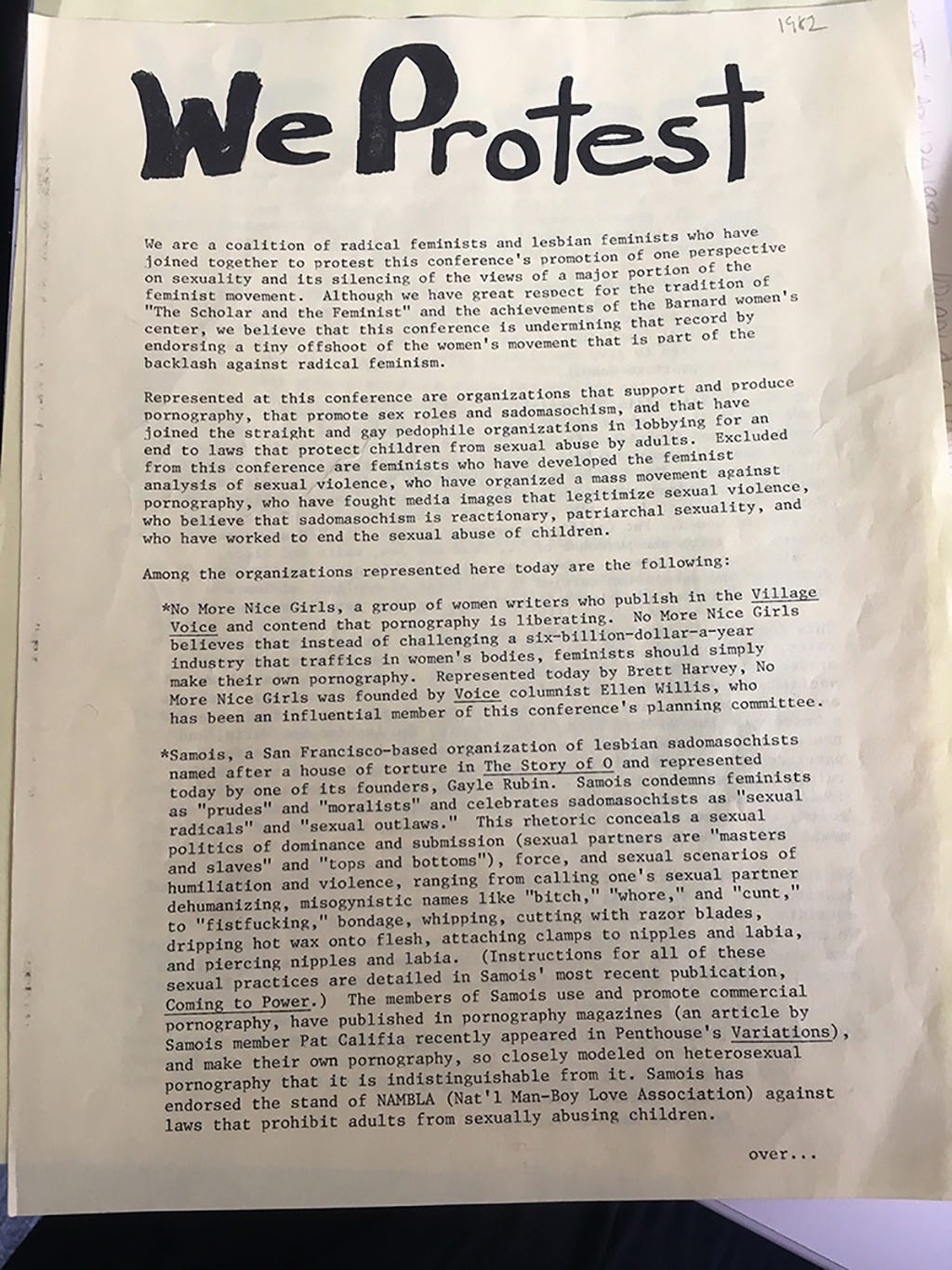
Rubin was a founding member of Samois, a San Francisco-based group that advocated for the acceptance of BDSM within lesbian and feminist spaces.⁷ This got her into trouble within movement feminism, which at this time was dominated by the view that sex is dangerous, a primary locus of male domination, particularly through the mechanism of sexual violence. It is no coincidence that a large section of Thinking Sex is devoted to a critique of anti-pornography feminism. Rubin, and her colleagues within Samois, had experienced vilification at the hands of anti-pornography feminists. A notable instance of this occurred at the 1982 Barnard Conference, now infamous for marking the beginning of the feminist “sex wars”.⁸ At this event, Rubin was explicitly targeted as part of a Women Against Pornography protest, as shown in the image below:
The other point to make here is that the political context within which Thinking Sex was written was genuinely concerning for gay rights. A campaign spearheaded by the religious right, initially fronted by Anita Bryant, and later involving Jerry Falwell and the Moral Majority, sought to roll back advances in gay liberation. Their coalition, initially called “Save Our Children”, capitalised on baseless fears that gay teachers would somehow “promote homosexuality” or influence students’ sexual orientation simply by being open about their own identity in educational settings. The campaign saw initial success, with anti-discrimination ordinances repealed in several locations including Dade County, Florida, St. Paul, Minnesota, and Eugene, Oregon.⁹ Given this climate, Rubin’s concern to defend dissident sexual practices is unsurprising. There was a legitimate concern that an emboldened religious right would leverage fears surrounding child pornography and sadomasochism, for example, as a wedge to target non-traditional sexual practices, both heterosexual and homosexual, more broadly.
Assessment
So where does all this leave us? Well, it’s clear that Thinking Sex does contain problematic material relating to paedophilia and the sexual exploitation of children. The impulse to defend “boy lovers” might be understandable if we’re talking about a 19-year-old and a 17-year-old, but the article does not draw the kinds of distinctions that allow one to explore the moral nuances of the issue. Moreover, there are frequent references to “cross-generational” sex, which does suggest larger age differences than those allowed by Romeo and Juliet laws.
Gayle Rubin has commented on the criticism directed towards her because of her views on boy-lovers. In a footnote to a 2011 reprint of Thinking Sex, she had this to say:
[L]et me be clear that I was primarily referring to consensual male homosexual relationships between adult men and teenagers at a time when many of the adult partners were being prosecuted over the objections of their younger lovers. In some cases the young partners clearly felt abused not by their lovers but by the legal process that was supposed to be protecting them.¹⁰
But again, the devil is in the detail. How old exactly are the teenagers? What’s the age gap? Have the teenagers been groomed? Moreover, even though some adult men report that they had rewarding sexual experiences with older men when they were teenagers, this tells us very little about the ethics of cross-generational sex and virtually nothing about appropriate legal frameworks. To understand why, let’s take a look at a notorious incident from the late 1970s, which saw a Toronto-based gay liberation magazine, Body Politic, prosecuted for publishing what is a straight up, unequivocal defence of paedophilia.¹¹
The article, “Men Loving Boys Loving Men”, written by Gerald Hannon, is a shocking read. (Please take that as a content warning for what is to follow.) One’s immediate reaction is to wonder how the editors could possibly think that it was okay to publish it. Ostensibly, it’s a sympathetic attempt to allow “men who love boys” to tell their own stories. But in reality it is an apologia for sexual grooming and child abuse.
“Simon” is a 33-year-old primary school teacher. His “lover” – a euphemism for victim, obviously – is 12 years old, and in Simon’s class at school. Yes, really. I don’t want to quote directly from the article, because it’s too disturbing, suffice it to say that it indicates that Simon is engaged in serious, systematic, sexual abuse of the young children in his classroom, some of whom are apparently pre-pubescent.
“Peter” is similarly compromised. He’s the perfect example of a sexual predator grooming his victims. He targets children who are “unwanted” or “unloved”. He describes a “long, long period of courtship”, impressing the child with a big car, “talking, driving around town, having a hamburger”:
It might take several months. Relationships that were budding in the summer would mature in the depths of winter in a car parked in a secluded spot in the snow. (Hannon, 1979, p. 23)
He feels no remorse, and doesn’t want to be different. His youngest victim was 7 years old.
I think we’ve heard enough with these two examples. The use of sanitising terminology such as “boy lovers” and “cross generational love” doesn’t alter the fact that what we’re talking about here is clearly paedophilia and the sexual abuse of children. There is no possibility of consent when the victims are in their early teens or younger, and when they have been systematically groomed. Moreover, to Rubin’s point that some “young lovers” (her terminology, not mine) don’t feel abused by their abusers. Well, yes, that’s a possibility, because it’s what can happen when people are groomed. That’s the whole point of grooming. But it doesn’t make the predatory dynamic ethical, and it doesn’t rule out long-term harm as victims come to a proper understanding of what has happened to them.
Perhaps your response to all this is to think, well, it’s horrifying, but surely Rubin can’t have meant this kind of clearly paedophilic behaviour when she was thinking about cross-generational love. Surely she meant 16-year-olds or 17-year-olds (now above the legal age of consent in the United Kingdom)?
Well, no, I don’t think she was talking only about older teens. I’ll offer three pieces of evidence here to support this contention, each more troubling than the last.
First, she indicates as much in Thinking Sex, advocating for the complete abolition of laws that deal with statutory rape (i.e., age of consent laws):
Legal struggle over sex law will continue until basic freedoms of sexual action and expression are guaranteed. This requires the repeal of all sex laws except those few that deal with actual, not statutory, coercion… (Rubin, 1984, p. 294)¹²
Second, while many people in the wider gay community reacted with horror to the publication of “Men Loving Boys Loving Men”, somebody called Gayle Rubin wrote to Body Politic to congratulate them on publishing the article. Obviously, I cannot be sure it’s the same Gayle Rubin, but other scholars, commenting on the letter, have taken it to be her, and the language is certainly familiar. This is how she starts the letter:
I want to express my unmitigated support for the paper and the Collective, and not just on the general grounds of freedom of the press… I also want you all to know that I think the decision to print the article was right (if not exactly expedient).
It is so important to raise consciousness about the status of the more “exotic” sexualities, genders, etc. Besides the injustice of the stigmatization of groups like pederasts, sado-masochists, transsexuals, etc., such groups are most vulnerable to attack. I have been watching with growing horror the pattern of arrests in the last year: adults charged with statutory molestation, prostitutes, men having sex in public restrooms. We are all being attacked by such arrests. (Rubin, 1978, p. 2)¹³
The third piece of evidence, by far the most troubling, comes from a 1981 interview with Rubin (and Pat Califia) that featured in the Book Review section of Gay Community News, in which she states she supports sadomasochism, public sex and promiscuity. That’s nothing we haven’t already seen, but the real trouble comes when the interviewer, Nancy Wechsler, asks her specifically about cross-generational sex. Her response is deeply problematic, as you’ll see from these excerpts (as before, take it that what follows comes with a content warning):
In cross-generational sex, as in every kind of sexual activity, there is a range from violent rape to the most exultant love. There are lots of relationships between people of different generations that are quite wonderful. We need to remember that kids are sexual… Essentially what the age of consent laws mean is that you literally don’t have the right to have sexual activity until you reach that magic age. I for one resented that enormously when I was growing up. We do a lot of damage to kids by making them really terrified of sex and keeping them from it, and pretending that it is a bad thing.
The age of consent laws are based on the idea that sex is fundamentally dangerous and inimical to the health of young people… There is a phony analysis of power that goes on in this whole debate. The assumption is that every time you have a relationship between people of different power statuses, it is a form of rape. The criticism some feminists have made of cross-generational sex follows the same kind of logic as the statutory rape laws. Whatever happens with someone under 18, or whatever the local age of consent is, is considered to be rape and molestation even if it is an older person giving pleasure to a younger person. (Wechsler, 1981, p. 5)¹⁴
It’s just about possible, despite Rubin’s talk of “kids”, that you still think she really means older teenagers. Well, she doesn’t. I can’t quote what comes next, because to do so would be to step over an ethical line, but I can tell you that Rubin suggests a scenario within which an adult gives pleasure to a 10-year-old child via the mechanism of a specific sex act, and then decries the fact that the adult could be treated as harshly as if it had been an act of non-consensual rape.
It is difficult to comprehend Rubin’s position on this matter. There are several glaring issues.
First, she fails to address how a 10-year-old could be in such a situation without having first been groomed.
Second, she overlooks the inability of a 10-year-old to give informed consent for sexual acts with an adult, regardless of the presence or absence of grooming. This is because: 1) a child does not have the intellectual or emotional capacity to make decisions in their own best interests with any consistency; 2) a child cannot understand the complex psychodynamics of cross-generational relationships, preventing them from fully grasping the character of the act within which they are involved; 3) a child lacks the capacity to make reliable judgements about risk and potential long-term harm; and 4) a child does not possess the moral reasoning ability to recognise with any reliability that a wrong is being done to them.
Third, she does not address the possibility that the adult predator is behaving badly even if it were possible for a 10-year-old to give informed consent (which it isn’t). There are lots of reasons to think that informed consent in this context does not make a sexual act morally acceptable: 1) the risks of short-term and long-term psychological harm are large; 2) there is inevitably a violation of the Kantian imperative not to treat other people solely as a means to an end: put simply, it is overwhelmingly likely that the adult predator in this scenario is just using the child for sexual kicks; 3) a cautionary principle should be in play to the effect that even if one allows for the hypothetical possibility of informed consent, adults should assume that in any particular instance there is no consent (for all the reasons we’ve detailed).
Fourth, there is a wider set of issues to do with the necessity for child protection. Rubin admits that there are genuine cases of child rape and abuse. If we lower the guardrails that protect children from the sexual interest of adults, allowing that cross-generational sex can be licit, then we will inevitably embolden adult predators. Children are more likely than adults to fall prey to tactics of coercion and manipulation; and they are much less likely than adults to be able to advocate for themselves in the face of psychological pressure from a predatory adult. The more that you dismantle the legal and moral guardrails that prohibit sexual contact between adults and children, the more you’re going to put vulnerable children in harm’s way.
I could go on, but at this point it should be clear that what’s going on here is straightforward apologetics for paedophilia, and it is rightly condemned as such. Derrick Jensen might have overstated the extent to which Rubin’s article, Thinking Sex, was a defence of paedophilia, but he is absolutely right that the author of that article has defended paedophilia.
Endnotes
1. Derrick Jensen, “Queer Theory Paedophilia Jeopardy”, excerpt from his Eugene Public Library talk, 4 March 2018. The video is linked in the opening paragraph. In email correspondence with the author on 8 October 2024, Jensen confirmed that the essay he described as the founding document of queer theory was Rubin’s “Thinking Sex”.
2. Camilla Mortensen, “Controversial Speaker Sparks Outcry: Protest Leads to Arrest at Eugene Library”, Eugene Weekly, 8 March 2018. Read the report.
3. The Joyful Warriors Podcast with Tiffany Justice, “What Is Queer Theory? with Derrick Jensen”, episode 62, 6 November 2023; discussion of the Eugene event from approximately 1:48, with the passage quoted above from approximately 5:07. Listen to the episode.
4. For reporting on the allegations concerning Foucault in Tunisia, see Die Zeit’s account and the statement by Foucault’s associates.
5. Gayle S. Rubin, “Thinking Sex: Notes for a Radical Theory of the Politics of Sexuality”, in Carole S. Vance (ed.), Pleasure and Danger: Exploring Female Sexuality (Boston: Routledge & Kegan Paul, 1984), pp. 267–319; passages cited in the article at pp. 272–73, 275, 279 and 294. Read an online reprint (pagination differs).
6. Paragraph-by-paragraph summary of “Thinking Sex”, prepared by the author; the highlighted entries identify references relevant to the discussion. Read the summary.
7. Leather Hall of Fame, “Samois (1978–1983)”, history of the group and its origins.
8. Tacie Dejanikus, “Charges of Exclusion & McCarthyism at Barnard Conference”, off our backs, vol. 12, no. 6, June 1982, pp. 5, 19–20. Issue contents; see also the account of the protest in In Visible Archives.
9. For the Dade County campaign and the subsequent repeals, see the Library of Congress, “Anita Bryant”, and the Oregon Encyclopedia, “Gay and Lesbian Rights Movement”.
10. Gayle S. Rubin, “Thinking Sex: Notes for a Radical Theory of the Politics of Sexuality”, in Deviations: A Gayle Rubin Reader (Durham, NC: Duke University Press, 2011), p. 143 and note 22, p. 385. Publisher’s listing.
11. Gerald Hannon, “Men Loving Boys Loving Men”, The Body Politic, no. 39, December 1977–January 1978, pp. 29–33; reprinted in no. 51, March–April 1979, pp. 21–24. The quotation in the article uses the 1979 reprint.
12. Rubin, “Thinking Sex” (1984), p. 294; see note 5 for the full publication details.
13. Gayle Rubin, letter to the editor, The Body Politic, no. 40, February 1978, p. 2. Read the letter (PDF, p. 4). See Becki Ross, “Like Apples and Oranges: Lesbian Feminist Responses to the Politics of The Body Politic”, FUSE, vol. 16, no. 4 (May/June 1993), p. 26, note 20; and Steven Maynard, “1969 and All That: Age, Consent, and the Myth of Queer Decriminalization in Canada”, The Abusable Past, 6 September 2019. For a subsequent discussion of the letter, see Kelly Phipps, “Look over here, look over there, lesbians are everywhere”: Locating Activist Lesbians in Queer Liberation History, PhD thesis, Concordia University, 2019, p. 118. Read the thesis.
14. Nancy Wechsler, “A State of Siege: The New Right and Sexual Repression”, interview with Gayle Rubin and Pat Califia, Gay Community News, vol. 9, no. 1, 18 July 1981, Book Review supplement, pp. 4–5; the quoted passage is on p. 5. Read the interview (PDF, p. 19).
Great tracking down of arguments right into their squalidest lairs. I did not know Gayle Rubin had gone so far and I already thought she was horrible
Hello Jeremy, Rubin's comments were made 40 years ago and more. I'm old enough (80) to have lived through the entire sexual "revolution" of the 60' and 70's, some of that time spent in Berkeley, California. Like all such movments, the sexual "revolution" went overbroad in its eagerness to destroy repressive codes and confused stupid codes, "all homosexualiity is mentally ill and sinful" with intelligent ones, "young child should not be sexually abused." Remember May 1968 and the slogan: "prohibiting is prohibited". The zeitgeist changes and a lot of important thinkers said things that shock us today from Aristotle on slavery to Nietzsche's misogyny and contempt for "slave morality."