


Nine months ago, Charlie Kirk, the right-wing political activist, was brutally murdered while speaking at a debate organised by Turning Point USA, the conservative youth organisation he founded. Unsurprisingly, news of his shooting unleashed ugly scenes among certain factions of the activist left. Perhaps most notoriously, PPE student George Abaraonye, the incoming president of the Oxford Union, seemed to welcome the attack, posting to WhatsApp and Instagram in celebratory terms – ‘Charlie Kirk got shot, let’s fucking go’; ‘Charlie Kirk got shot loool’ – despite having taken part in a debate with Kirk only three months earlier.
Abaraonye soon discovered that freedom of speech doesn’t mean freedom from criticism or consequences – or, in his case, a large dose of irony. His remarks were quickly condemned by Oxford University and the Oxford Union. He became a trending topic on Twitter (X) – vilified for his remarks, but also for what he supposedly represented (as in this fatuous tweet, which garnered some 53 thousand likes).


Eventually, Abaraonye was forced to resign as president-elect of the Oxford Union, after losing a vote of no-confidence that he had instigated himself.
We already know that student activists like to run their mouths, that the media love a scandal involving Oxford or Cambridge, and that social media is a cesspool, so what’s the interest here?
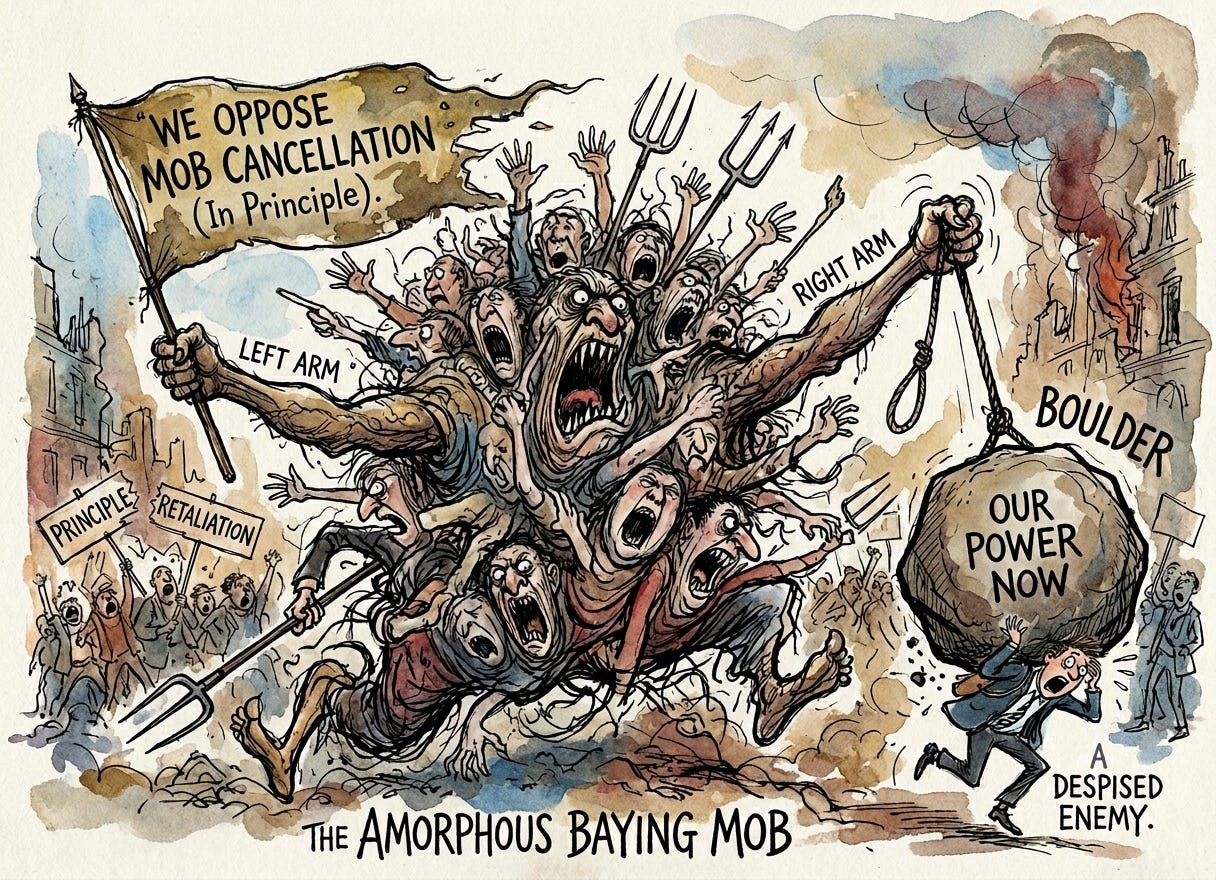
The interest is that Charlie Kirk’s assassination provided the opportunity for the right-wing to weaponise a cancellation playbook that up to then had been the near-exclusive preserve of left-wing activism. For years, conservatives had complained about cancel culture, but in the aftermath of the killing, emboldened by the social and cultural shift brought about by Trump’s victory in 2024, they lost no time in turning the left’s weapon of choice back upon them.
The campaign was industrial in scale. Twitter accounts such as Libs of TikTok orchestrated a crowd-sourced counteroffensive to identify, dox and target anyone who had expressed even mild schadenfreude in the aftermath of Kirk’s death. Mainstream Republicans, including J. D. Vance, got involved, encouraging people to contact employers, threatening to defund schools and colleges that refused to discipline staff, and suggesting that people who celebrated Kirk’s death should be “thrown out of civil society”.
Lots of the people caught up in this digital dragnet had said ugly things, but not all of them. Not that it mattered — once the pitchforks were out it was tough luck if you caught the attention of the baying mob, because — as we’ve known for at least 15 years now — truth and justice are the first casualties in a campaign of cancellation.
Part of what makes this incident interesting is that it suggests that conservatives might have changed their minds about cancel culture now that they can at least compete with the left in the social and cultural sphere. If a political faction doesn’t have the power to effect a cancellation, then it’s not surprising if they oppose cancellation as a matter of principle. But what about if they do have the power — what happens to the principle then?
Think Again
I have some data that suggests at least the beginnings of an answer to that question. It comes from an experiment I’ve been running on Think Again, a philosophy app I’ve put together.

The experiment is called “Whose Side Are You On?”, and it looks at whether people will reject specific political policies and commitments if evidence emerges that throws those policies and commitments into grave doubt.
The experiment begins by asking a short set of political-orientation questions, which allows us to allocate people into three broad categories: left-wing, conservative and libertarian. The assumption is that left-wing people will find it easy to reject right-wing policies and commitments in the light of evidence that falsifies them, but they’ll find it hard to give up left-wing policies and commitments even if the contrary evidence is just as strong. The pattern is assumed to be the reverse for conservatives (easy to reject left-wing beliefs, but hard to give up right-wing beliefs), and mixed for libertarians. Obviously, whether these assumptions turn out to be true will be determined by what the data actually says.
So what’s all this got to do with cancellation culture? Well, the experiment features a pair of linked questions that vary the political cost of endorsing an anti-cancellation principle. Put simply, one question features a scenario where left-wingers are being cancelled; the other a scenario where cancellation is directed at someone caught making unambiguously racist remarks. The suspicion is that people will be more willing to endorse an anti-cancel principle when doing so carries little political or moral cost. The key question is not whether people reason tribally — of course they do — but whether some tribes reason more tribally than others.
What the Data Shows
The headline news is that the left is far more partisan than the right on the issue of cancellation. After 1,047 responses, it’s not even remotely close. Here’s what the data shows.
The politically costly case for left-wingers involves someone caught on video making unambiguously racist remarks, in a context where incontrovertible evidence has emerged linking cancel culture to harm, the chilling of free speech and the suppression of conservative viewpoints.
The politically costly case for conservatives involves people celebrating the assassination of a prominent right-wing figure, in a context where right-wing commentators and free-speech organisations have consistently opposed cancel culture.
Users are shown both cases, and each time asked whether they will endorse an anti-cancel principle.
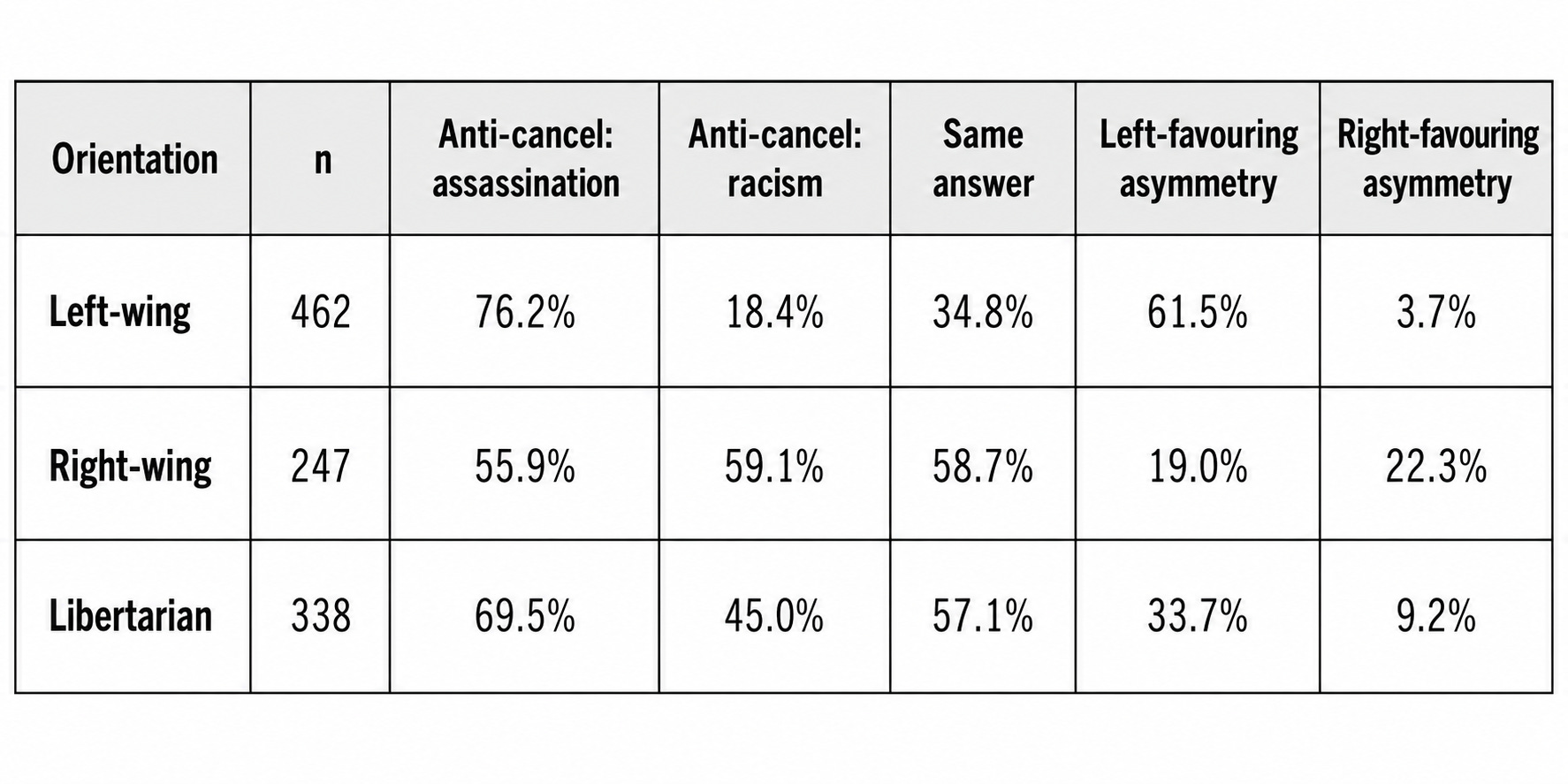
When the numbers are tallied, the results reveal a massive, asymmetrical gulf in partisan consistency. For left-wing users, the anti-cancel principle disappears when it collides with a core shibboleth. While 76% of the left will endorse the anti-cancel principle when their own side is in the crosshairs, that number craters to just 18% when the scenario involves a video of unambiguous racism. It is a staggering 58-point drop that shows the principle is overwhelmingly contingent on the particular circumstances in play.
By contrast, conservatives display a striking consistency in the abstract. When the scenario involves someone being cancelled for racist remarks, 59% of conservatives uphold the anti-cancel principle. When the scenario shifts to the ultimate provocation — people ghoulishly celebrating the assassination of a right-wing commentator — that figure only falls slightly to 56%.
Reflections on Methodology
Obviously, we’ve got to be careful not to overclaim here. There are a number of pertinent methodological points.
First, order effects: the app actually controls for order effects, by varying the scenario that is presented first to the user. But in fact what the data shows is that there are no order effects anyway. So, for example, it doesn’t matter if a left-wing user sees the assassination case first, endorsing the anti-cancel principle, because they still tend to switch their answer when it comes to the racism case. This pattern is left-favouring asymmetry in the table above.
Second, the political-orientation test: yes, obviously it’s a blunt instrument. But it seems to have what is termed “construct validity”: in other words, it picks out what you’d expect it to pick out if it were tracking genuine political differences, evidenced by the stark contrast in how left-wing and conservative “buckets” respond to the cancellation questions. Pure randomness in the group assignments would have produced noisy, patternless data. Instead, we find highly patterned, explicable results that align perfectly with previous polling data on how these groups tend to view cancellation (at least in the abstract).
Third, there is messiness in the experimental design (mainly because it was never intended to be a rigorous test of how different groups view cancellation). For example, racist speech isn’t the same sort of thing as celebrating the assassination of a right-wing personality. There are certainly reasons why one might think racist speech is worse than celebrating the murder of a political opponent; and vice versa, of course.
It is also the case that there is no random sampling involved here. There will be systematic differences between the kind of people who access a philosophy app and the population as a whole. So it simply isn’t possible to generalise out from these findings. The data is almost certainly indicative of real differences between groups, but the cohorts here are younger, better educated, more engaged and more online than the population as a whole.
Conclusion
Where does this all leave us? Well, the data from Think Again suggests that, in the abstract at least, many conservatives possess a genuine commitment to an anti-cancellation principle. More than half in our sample remain opposed to cancellation even when we’re talking about people celebrating the murder of one of their own.
The left, by contrast, appears to be relatively instrumental on this issue — what counts is the ideological identity of the target, and the political character of the offence. It is not unreasonable to conclude that for at least some portion of the activist left cancellation is a cudgel to be wielded for contingent political reasons, rather than a socio-political phenomenon that ought to be judged on its own merits.
But there’s a twist here. In the real world, neat abstractions don’t do the moral work one might hope. The aftermath of Charlie Kirk’s murder demonstrates that it doesn’t really matter how people respond to surveys when they’ve got no blood in the game. Everything changes if the outrage is fresh and there are barbarians at the gate.
For years, the right-wing defence of free speech and opposition to cancel culture was easy to maintain because conservatives lacked the socio-cultural power to weaponise social opprobrium. But that’s not quite true anymore. Donald Trump and Elon Musk have changed the rules of the game. And it turns out that power corrupts even principles that might be genuinely held when the stakes are high enough and the outrage runs deep enough.
On the whole, people don’t imagine themselves to be modern-day Jacobins, readily coopted into a mob in the name of a bastardised truth, honour and justice. But the reality is that everybody opposes the mob right up until the moment it can be deployed to enact righteous vengeance upon a despised enemy. The left developed and deployed cancellation as the perfect guillotine for the internet age. It’s not in the least bit surprising that the right have seized its levers, and turned it back against its architects.
I clicked on your app and it says only for Iphone. I have a Samsung phone myself. Iphone users tend to have higher incomes simply because they're expensive. Wouldn't that affect your data?